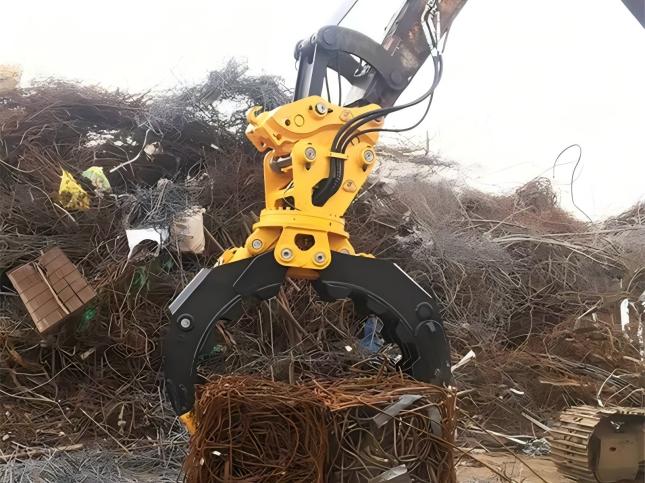
How a Forestry Company Improved Efficiency with Dewanda’s Grapple

Case Study: How a Forestry Company Improved Efficiency with Dewanda’s Grapple
A mid-sized forestry contractor in the Pacific Northwest was facing increasing pressure on margins. Their core business—harvesting, sorting, and staging timber for regional sawmills—relied on small fleets of excavators fitted with antiquated handling tools. Logs were heavy, irregular, and often had to be repositioned multiple times before loading; residual debris clogged yards, and operator fatigue was rising. Cycle times were long, fuel use per cubic meter of processed timber was high, and safety incidents from manual repositioning or inadequate grip were creeping upward.
The company approached Dewanda after hearing about a peer who had retrofitted a similar operation with a purpose-built excavator grapple. The request was specific: they needed a forestry attachment that would stop the frequent slippage and drop-offs during handling, reduce unproductive repositioning, and allow a single machine to handle both sorting and loading with minimal tool swapping. The keyword driver in their RFP was clear—excavator grapple that could survive rough woods work, give precise control over irregular logs, and integrate with their existing 20- to 26-ton excavator fleet without costly modifications.
Baseline Challenges and Operational Pain Points
Before Dewanda’s intervention, the company was using a mix of generic clamshell-style grapples and manual rigging. Several recurring inefficiencies had been documented over the previous 12 months:
High cycle time per log: On average, it took 2.1 minutes to pick, orient, and load a standard 4-meter Douglas fir log onto transport or staging piles. This included time spent regripping due to slippage (about 18% of single pick attempts required a second grip).
Fuel inefficiency: Excavators were operating at 75–80% load factors, burning approximately 13 liters of diesel per cubic meter of timber moved. Idle time for repositioning and corrective maneuvers accounted for roughly 22% of total engine hours.
Material sorting delays: Logs of mixed diameters and lengths had to be manually separated after initial pickup since previous grapples lacked the finesse to place logs precisely for downstream processing.
Safety and crew fatigue: Operators were often required to manually assist in repositioning fallen logs or stabilizing uneven loads, leading to near-miss incidents that increased insurance premiums and disruptive delays. The lack of rotation capability in existing grapples forced operators to swing the entire excavator to reorient pieces, adding stress to undercarriage and boom components.
Tool wear and downtime: The existing grapples were not designed for the abrasiveness of bark, embedded dirt, and occasional stumps; pivot pins and hydraulic cylinder seals failed prematurely, leading to average downtime of 10 hours per machine per month for repairs.
The forestry company quantified the cumulative impact: lost throughput equated to approximately 15% less timber processed per shift than comparable competitors, and maintenance plus fuel drained an estimated $2.30 per cubic meter of processed timber beyond target.

Dewanda’s Excavator Grapple Solution Design
Dewanda’s field engineers conducted an on-site assessment over three days, riding with operators, timing cycles, observing grip failures, and cataloging the types and dimensions of logs being handled. The evaluation matrix included log weight variation (300–1,200 kg for 4m species), surface contamination (mud, ice, embedded small roots), yard layout constraints, machine hydraulic flow profiles, and typical operator handling patterns.
High clamping force with precise modulation to prevent slippage on smooth or wet bark.
360° rotation so logs could be oriented without repositioning the base machine.
Wide jaw opening with tapered teeth to accommodate varying diameters from 25 cm to 70 cm.
Durable pivot and sealing system tolerating abrasive humus and seasonal freeze-thaw cycles.
Compatibility with existing quick coupler systems on the fleet’s Komatsu PC220 and Volvo EC240 excavators without needing custom subframes.
Minimal additional hydraulic demand so the existing pumps wouldn’t need upgrading.
Dewanda proposed a custom hydraulic rotating excavator grapple built on the proven dual-cylinder clamshell geometry, optimized for forestry attachment work. Major features included:
Reinforced, replaceable serrated tines fabricated from HARDOX 450 wear steel with aggressive profile for bite on bark and embedded debris, yet contoured to avoid damaging usable timber.
Independent rotation motor allowing continuous 360° rotation without interrupting grip, using a sealed planetary gearbox and integrated slip ring assembly to power sensors and optional cameras.
Flow-matched valve manifold that piggybacked off each host machine’s auxiliary circuit; the control was calibrated to provide proportional pressure to the grapple cylinders to allow fine opening/closing and powerful clamping without shock.
Integrated grease ports and debris wipers at all pivot points to prevent infiltration of dirt into bushings; fitted with high-grade bronze sleeve bushings and double lip seals for the rotation assembly.
Load sensing feedback that could optionally be routed to the operator’s display, providing a grip force indication to reduce over-clamping (which can bruise logs) or under-clamping (which causes drops).
Soft-touch zone: an adjustable mechanical stop to prevent over-closing on delicate or smaller logs, reducing internal back pressure on the hydraulic system and improving lifespan.
Bolt-on adapter plates aligned with the excavators’ existing coupler systems, ensuring fast swap-in without special welding or modifications.
Dewanda delivered three prototype grapples for field trial: a standard 1.8-meter jaw width version, a narrow version for close-quarters within log decks, and a heavy variation with additional reinforcement for handling root balls and small stumps.
Implementation and Operator Integration
Installation was handled by Dewanda’s regional technician team over a two-day window. Each excavator received:
Calibration of hydraulic flow and pressure to the grapple’s optimal working envelope (established during bench testing).
Quick operator workshops (two hours per crew) covering:
Judging effective gripping points
Rotational orientation without repositioning the carrier
Use of the load-feedback gauge to avoid over-stress
Daily maintenance checks (greasing points, seal inspection, bleed-down practices)
Operators were initially skeptical—many had spent years fighting with inadequate grabs. That skepticism turned to rapid adoption once they experienced the combination of consistent grip, rotation, and ease of placement. The narrow model proved invaluable in compact sorting yards, while the heavy variation enabled the same machine to pull partially embedded root stumps before loading.
Quantified Improvements in Field Performance
Data was collected over a 90-day evaluation period, using a combination of telematics data from excavators, manual cycle timing, fuel receipts, and operator logs. The results were substantial:
1. Cycle Time Reduction
Average time to pick, orient, and place a 4m log dropped from 2.1 minutes to 1.3 minutes— a 38% reduction.
Rotational capability alone eliminated the necessity for track repositioning in 72% of log orientation tasks, reducing track wear and operator fatigue.
2. Fuel Efficiency
With smoother picks and fewer corrective swings, diesel consumption per cubic meter of timber processed decreased from 13 liters to 9 liters—a 30.8% improvement in fuel efficiency. The company projected annual diesel savings of over 8,000 liters across the retrofitted fleet.
3. Throughput Increase
The operator team processed an average of 22% more timber per shift, attributable to faster cycles and reduced secondary handling. Peak day throughput increased from 145 cubic meters to nearly 180 cubic meters with the same manpower.
4. Reduced Regrips and Drops
Grip failure (requiring a second attempt during a single log pick) went from 18% down to 3%. Log drops that previously caused needed re-handling and damaged bark reduced by 85%, which also lowered downstream sorting rejection rates due to damaged lumber.
5. Decreased Downtime
Prior grapples averaged 10 hours of service downtime per machine per month due to seal replacement, pin wear, and minor repairs. Dewanda’s grapples, with their debris wipers and improved seals, reduced that downtime to 2.5 hours per month, a 75% reduction. Maintenance cycles extended from biweekly to monthly for primary pivot points.
6. Safety and Ergonomics
Operators reported fewer near-miss incidents related to manual adjustments (which dropped by 90%) and reduced need to “ride” the logs with the bucket to stabilize them. The ability to orient logs without moving the carrier also lowered the risk of tipping on uneven ground. The cleaner sorting decks meant less manual cleanup, further reducing exposure.
7. ROI and Payback
The forestry company tracked cost impacts: improved throughput and fuel savings, combined with lower maintenance and reduced labor touchpoints, yielded a payback period of 4.5 months on the initial grapple investment. After one year, the grapples had contributed to a net operational cost reduction estimated at 18% for the retrofitted yard segment.

Adaptations and Scaling
Following the success of the initial deployment, the company expanded the use of Dewanda excavator grapples to two additional sites with different timber species and yard layouts. Adjustments included:
A slightly wider jaw version for longer softwood logs to improve stable cradle handling.
Addition of a quick-disconnect camera mount to assist in blind picks under canopy cover.
Custom paint and identification tags for rapid tool matching during shift changes.
Dewanda also developed a seasonal maintenance kit for the grapples, including premium grease, replacement wipers, and a field gauge for preload checking. Remote diagnostics sessions were scheduled monthly during the first year to ensure optimal performance and address operator questions.
Why the Dewanda Grapple Worked Where Others Didn’t
Several factors differentiated Dewanda’s forestry attachment from legacy grapples:
Feature combination: Not just grip strength, but the integration of rotation, grip feedback, and soft-touch stops gave operators situational control without sacrificing power.
Fit without modification: Bolt-on adaptation to the existing coupler systems eliminated expensive downtime that would have been required for custom mounting.
Material and seal specification: Abrasive wood fiber, frequent moisture, and bark grit are brutal on moving assemblies. Dewanda’s use of sealed bearings, triple-lip rotary seals, and wipers prevented ingress that previously compromised competitors’ grapples within weeks.
Training and feedback loop: Early operator input led to minor field tweaks (adjustable clamp pressure curve, updated operator decal for grip-force interpretation), which were implemented in the second batch without extra charge.
Lessons Learned and Best Practices That Emerged
From this engagement, a few operational truths surfaced that Dewanda now includes in every forestry attachment deployment:
Pre-deployment slope assessment: Some yard areas had hidden soft spots. Best results came when grapple-equipped excavators approached from stable ground, minimizing log swing during placement.
Use of grip feedback: Operators who ignored the grip-force gauge initially tended to over-clamp, bruising lumber; those trained to dial in pressure maintained speed without damaging product.
Scheduled greasing: A simple 2-minute daily greasing ritual at the pivot points preserved smooth operation, especially when shifting from wet morning conditions to dry afternoons.
Staging strategy: Placing logs in pre-defined zones based on species and size, combined with precise placement from the grapple, reduced secondary sorting time by 40%.
Expansion to New Forestry Attachment Use-Cases
The success in log handling encouraged the company to trial additional forestry attachments from Dewanda, including:
Delimber hooks adapted to the same grapple frame for preliminary limb removal before log staging.
Specialized sorting tongs that worked in tandem with the grapple for bundle creation.
Combined grapple-saw units for on-the-move sectioning of difficult stems in dense brush.
Each of these integrations benefited from the operator familiarity established during the grapple rollout, shortening the learning curve.
Ongoing Relationship and Future Plans
The forestry operator now lists Dewanda as a preferred partner in new bid packages. They’ve integrated performance data from grapple-equipped machines into their costing models and are piloting a fleet-wide standardization of Dewanda grapples for all harvesting support yards. Discussions are underway to co-develop a next-generation “smart” forestry attachment that includes telemetry reporting grip efficiency and predictive maintenance alerts.
Optimizing material handling with excavator gripper in norway