Does a small excavator need a larger hydraulic cylinder when equipped with a long reach arm?

For small excavators, such as those with a capacity of 6 to 8 tons, the longest extended arm can reach 12 meters. The oil cylinder can be directly returned to the original vehicle's oil cylinder without the need to increase the size of the oil cylinder. There will be no situation where the boom cannot be lifted. Besides, it should be noted that due to stability issues, small excavators are not suitable for having overly long extended booms. For a 6-ton extended boom of 12 meters, a counterweight of about 1 ton is needed; otherwise, it is easy to lift the bottom.
1. Common Needs for Small Excavators with Long Reach Arms
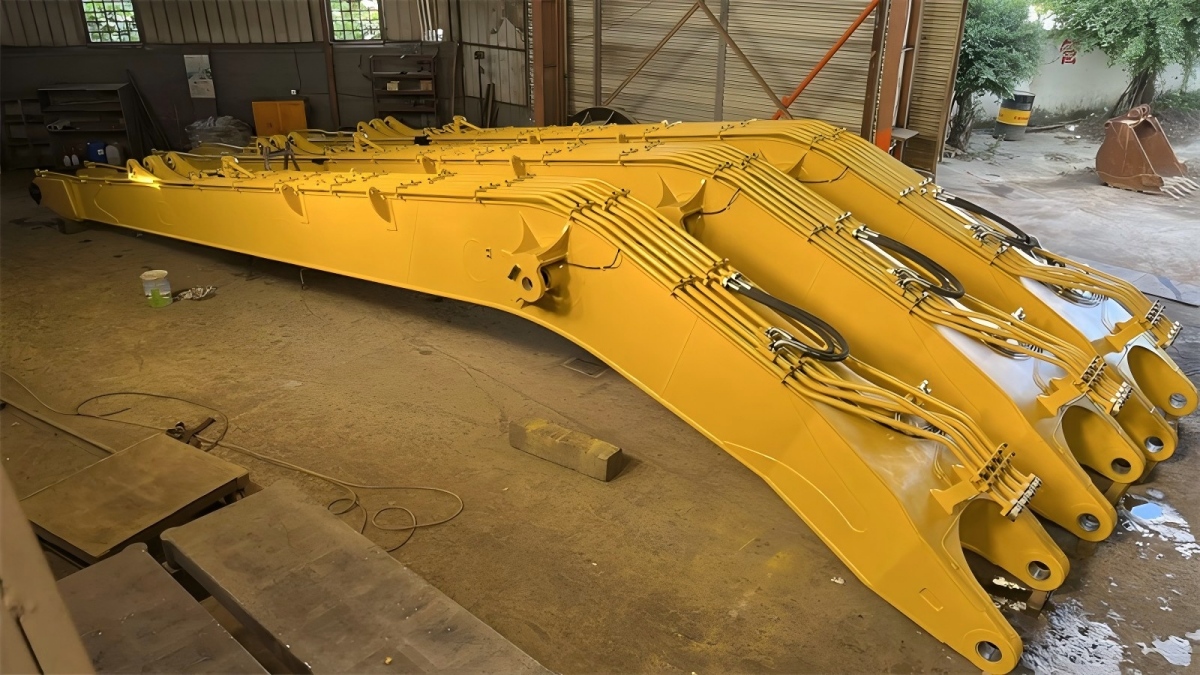
Small excavators, especially those in the 6 to 8-ton class, are becoming increasingly popular in the market. These machines are compact and flexible, ideal for working in tight spaces. By equipping them with long reach arms, their working range can be significantly extended. This is particularly useful for dredging rivers, shaping slopes, and cleaning ponds—jobs that require reach but don’t demand high ground pressure.
One of the most frequently asked questions when modifying small excavators with long reach arms is whether the hydraulic cylinders need to be upgraded.
2. No Need to Replace Hydraulic Cylinders for 6–8 Ton Machines
Based on practical experience, for 6–8 ton excavators, the commonly used long reach arms range from 10 to 12 meters in length. Within this length, the machine’s original hydraulic system and cylinders are fully capable of supporting the long arm’s operation. This means the standard cylinders can smoothly handle lifting, extending, and retracting the arm without any issue.
The reason lies in the hydraulic systems of modern small excavators, which are typically designed with sufficient output capacity to accommodate a variety of attachments. Even though the long reach arm extends the machine’s working device, its structure is engineered using high-strength lightweight steel. The overall weight remains manageable and doesn’t overload the original cylinders. As long as the long reach arm is designed to fit the original excavator dimensions, there is no need to worry about insufficient lifting power.
3. Stability Is Key After Installing a Long Reach Arm
While there’s no need to replace the cylinders, stability becomes a crucial factor once a long reach arm is installed. Due to the forward shift of the machine’s center of gravity and the extended arm length, the rear of the excavator can easily lift off the ground—especially during high-angle lifting or when handling a loaded bucket.
Without additional counterweight, the machine may tilt backward or experience track lift, reducing safety and work efficiency. For example, when installing a 12-meter long reach arm on a 6-ton excavator, it is recommended to add approximately 1 ton of counterweight. This can be achieved by hanging extra weight blocks or upgrading to a reinforced counterweight box. Proper counterbalancing improves operational stability and gives the operator more confidence when working at full reach.
4. System Adjustments After Installing a Long Reach Arm
After installation, it's important to make some system adjustments to optimize performance. These may include fine-tuning the return flow of the control valves, adjusting stroke limiters, and re-routing or extending hydraulic hoses. These small changes significantly affect machine performance.
Professional manufacturers often provide full sets of components and technical recommendations, such as oil pipes, pins, and installation guides, making it easier for users to integrate the new arm without affecting machine function.
5. Real-World Case Study: Long Reach Arm on a 7-Ton Excavator
One customer who performs river dredging had concerns about whether his 7-ton excavator could handle a 12-meter long reach arm without cylinder upgrades. After on-site testing and demonstration, he found that the machine's original cylinders handled all operations smoothly, including arm lifting, extending, and digging. Once additional counterweight was installed, the machine operated stably. The customer later reported frequent use of the long arm with great satisfaction regarding its performance.
6. Choosing the Right Tool for the Right Job
It’s important to understand that a long reach arm is not suitable for every type of task. For high-intensity work such as rock breaking, heavy-duty loading, or deep excavation, a standard boom and arm setup may be more appropriate. Long reach arms are best used for wide-area, low-resistance operations. Users should carefully evaluate their job requirements before selecting a long reach arm to ensure the modification increases productivity rather than limits it.
7. Structural Design and Safety Considerations
Long reach arms on the market are usually made from high-tensile steel plates with internal reinforcements and dual-pin connections between the boom and stick. Extended hoses and quick couplers are also added to ensure proper strength and flexibility. With this engineering, even small excavators can perform extended reach operations up to 12 meters while maintaining structural integrity and safe operation.
8. Smart Configuration Brings Big Results for Small Excavators
Equipping a 6–8 ton excavator with a 10 to 12-meter long reach arm is a proven, effective solution that does not require replacing the original hydraulic cylinders. Instead, attention should be paid to counterweight balance and correct operation techniques. With proper installation and responsible use, small excavators can tackle wide-area tasks efficiently, unlocking their full potential on specialized job sites.
Contact us for more information //www.dewandaparts.com/
Are volvo truck engines the same as excavator engines?
How to choose the right excavator long reach boom ?