How long can the long reach boom of a 10-15 ton excavator be made? How should counterweights be added?

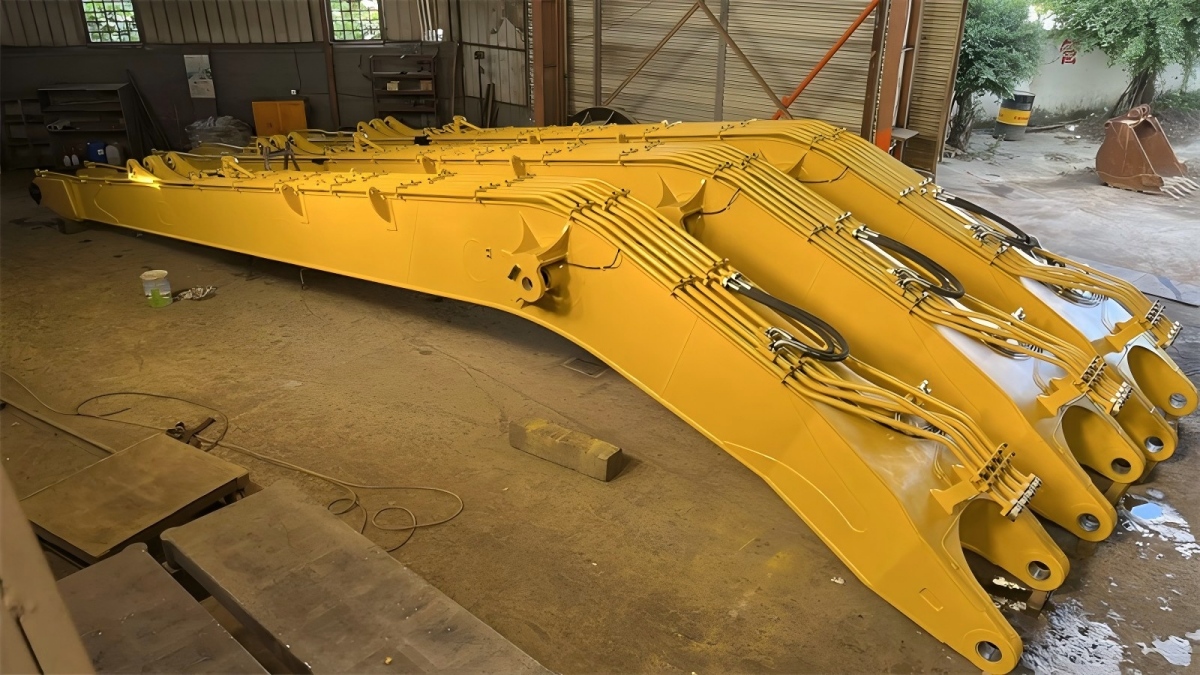
In infrastructure development, river dredging, foundation excavation, and similar projects, long reach excavators are increasingly favored for their extended operating range and strong job site adaptability. For mid-sized excavators in the 10–15 ton range, retrofitting with a long reach boom has become common practice to enhance performance in specific working conditions. So, how long can a long reach boom be for this tonnage range? And how should counterweights be configured?
1. 10–12 Ton Excavators: Recommended Boom Length and Counterweight Configuration
For 10–12 ton excavators, such as Komatsu PC120, CAT 312, Hyundai R125LCR, and SANY SY135, the machine weight is relatively light, and engine power is moderate. Therefore, long reach boom modification must consider stability and compatibility with the hydraulic system.
Recommended Boom Length: 10–14 Meters
Generally, the most common long reach boom length for this range is 12 meters. Lengths from 10 to 14 meters can be customized:
10 meters: Suitable for short- to medium-range dredging or basic excavation tasks. Minimal impact on machine stability.
12 meters: The most popular length in the market. Offers broad application with good operational control.
14 meters: The maximum limit. Suitable for specialized long-range operations but requires additional structural strength and counterweight.
Recommended Counterweight:
To ensure operational safety and machine balance during use, adding counterweight is essential.
12-meter boom: Add 1 ton of counterweight.
14-meter boom: Add 1.5 tons of counterweight to prevent tipping or track slippage.
Counterweights can be mounted at the rear of the excavator using bolt-on or welded blocks. Custom internal reinforcements are also available depending on working conditions.
Bucket and Cylinder Setup:
Recommended bucket capacity: 0.3 cubic meters, which balances digging efficiency and weight.
Bucket cylinder: Use cylinders designed for 6-ton machines, ensuring smooth and reliable bucket motion.
2. 15 Ton Excavators: Greater Capacity and Modification Potential
15-ton machines, such as Hitachi ZX150, Doosan DX150, Kobelco SK150, and SANY SY155, offer stronger undercarriage support and hydraulic power, making them ideal for long boom modification.
Maximum Reach: 15 Meters
With stronger structural support, 15-ton excavators can handle longer booms:
With stronger structural support, 15-ton excavators can handle longer booms:
Up to 15 meters: Maximum feasible length with careful hydraulic and structural matching. Ideal for long-distance dredging and slope work.
12 meters: More commonly used length with balanced performance and widespread use in water conservancy and river maintenance.
Recommended Counterweight:
According to different boom lengths:
12-meter boom: Add 700 kg counterweight.
15-meter boom: Add 2 tons of counterweight for stability at full extension.
These machines usually come with heavier factory counterweights, so added weight should be installed safely and tested under real conditions.
Bucket and Cylinder Setup:
Bucket: Still recommended at 0.3 cubic meters, controlling weight and maintaining hydraulic efficiency.
Hydraulic cylinder: Upgrade to cylinders used in 7–8 ton class machines to enhance durability and digging performance.
3. Real-World Case Studies
Case 1: 12-Ton Excavator with 12m Long Boom (+1 Ton Counterweight)
Application: Dredging a small reservoir, with a required reach over 10 meters.
Application: Dredging a small reservoir, with a required reach over 10 meters.
Setup: 0.3 m³ dredging bucket, 60-series bucket cylinder, and 1-ton rear-mounted counterweight.
Feedback: Significantly improved reach, smooth operation, and stable performance. Client satisfaction was high.
Case 2: 15-Ton Excavator with 15m Long Boom (+2 Tons Counterweight)
Application: Riverbank reinforcement project requiring ultra-long reach.
Application: Riverbank reinforcement project requiring ultra-long reach.
Setup: 15-meter custom boom, 0.3 m³ trenching bucket, 2-ton bolt-on counterweight.
Feedback: Excellent extended reach, stable movement, perfectly suited to demanding site conditions.
4. Modification Tips and Precautions
Assess base machine condition first: Before modification, check machine age, undercarriage health, and hydraulic pressure capabilities.
Work with professional manufacturers: Boom design must meet load-bearing standards and welding quality requirements to avoid fatigue or breakage.
Install counterweights safely: Counterweights should be securely fastened and not interfere with rotation or transportation.
Avoid oversized buckets: Oversized buckets strain the hydraulics and reduce motion responsiveness.
Routine maintenance is key: Regularly inspect boom pins, cylinder seals, and weld joints for wear or cracks post-modification.
For 10–15 ton excavators, adding a long reach boom significantly extends their working radius and boosts job site efficiency. However, success depends on scientifically matching boom length, counterweight, bucket size, and hydraulic components. With proper configuration, these machines can deliver excellent performance in specialized excavation environments.
If you’re considering custom long reach solutions or need technical support, feel free to contact Dewanda manufacturer for a tailored modification plan.
Contact us for more information //www.dewandaparts.com/
How Long Can a 24-Ton Excavator's Long Reach Arm Be? How Much Counterweight Is Required?
Can a 3.5 ton mini excavator be equipped with a long reach boom?