How Long Can a 24-Ton Excavator's Long Reach Arm Be? How Much Counterweight Is Required?

In construction work, an excavator's operating radius and digging depth often determine its efficiency and range of applications. To meet the demands of specific job sites, many customers choose to equip their machines with long reach arms. For mid-to-large-sized excavators, especially 24-ton models, it’s crucial to understand how long of a boom can be installed and how much counterweight needs to be added. This article answers those questions in detail.
1. Key Features of 24-Ton Excavators
The 24-ton excavator is a mainstream medium-large machine with excellent stability, load capacity, and operational efficiency. Major brands such as CAT, Komatsu, Hitachi, SANY, XCMG, and Liugong all offer reliable models in this tonnage range. Standard arm length for these machines typically ranges from 9 to 10 meters, with bucket capacity around 1.0 m³—suitable for general earthworks and foundation jobs.
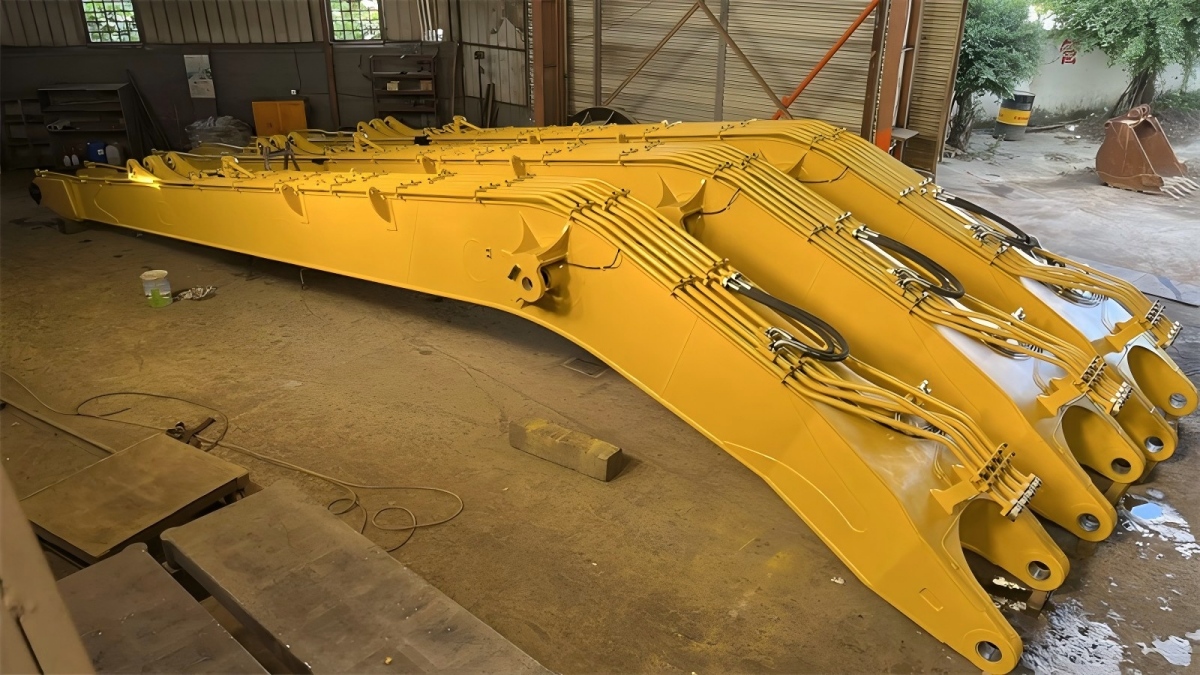
When required to dig deeper channels, riverbeds, or unload materials from a distance, the standard boom can no longer meet the demands, and a long reach arm becomes necessary. A long reach arm generally includes the boom, stick, bucket, and cylinders, allowing for significantly increased digging depth and reach.
2. Recommended Setup for a 16-Meter Long Reach Arm on a 24-Ton Excavator
The 16-meter configuration is one of the most commonly used long reach setups for a 24-ton excavator. It offers an extended operating radius without compromising too much on the machine’s overall balance and safety.
Recommended Configuration:
Bucket size: 0.45 cubic meters
Ideal for light-duty work such as dredging and silt clearing, avoiding overload risks.
Bucket size: 0.45 cubic meters
Ideal for light-duty work such as dredging and silt clearing, avoiding overload risks.
Cylinder selection: Use bucket cylinders from a 12-ton excavator
The reasoning is that the extended arm increases the force at the front. Using the original 24-ton cylinders would increase the arm weight, while 12-ton cylinders reduce the front-end load and improve control response.
The reasoning is that the extended arm increases the force at the front. Using the original 24-ton cylinders would increase the arm weight, while 12-ton cylinders reduce the front-end load and improve control response.
Counterweight requirements:
With a 0.45 m³ bucket: No extra counterweight needed.
With a 0.6–0.8 m³ bucket: Add 500 kg to 1 ton of counterweight.
Larger buckets mean more load and torque, increasing the risk of front instability without proper balancing.
Larger buckets mean more load and torque, increasing the risk of front instability without proper balancing.
3. Recommended Setup for an 18-Meter Long Reach Arm
The 18-meter boom is a longer setup that places greater demands on machine stability and hydraulic balance.
Recommended Configuration:
Bucket size:
Bucket size:
Preferably 0.45 m³ bucket for safe and balanced operation.
A 0.6 m³ bucket may be used when higher output is necessary, but must be counterbalanced accordingly.
Counterweight requirements:
With a 0.45 m³ bucket: Add 500 kg of counterweight.
With a 0.6 m³ bucket: Add 1 ton of counterweight.
Suitable Applications:
This configuration is ideal for river dredging, deep trenching, municipal de-silting, and pond cleaning. Heavy-duty buckets are not recommended in this case to ensure equipment stability.
This configuration is ideal for river dredging, deep trenching, municipal de-silting, and pond cleaning. Heavy-duty buckets are not recommended in this case to ensure equipment stability.


4. Setup Guidelines for a 20-Meter Super Long Reach Arm
Some job sites may require extreme reach, leading customers to consider a 20-meter boom setup. This is the upper limit for most 24-ton excavators and demands precise engineering and additional support.
Recommended Configuration:
Bucket size: Strictly limited to 0.45 m³ or smaller.
Heavy-duty or rock buckets must not be used.
Bucket size: Strictly limited to 0.45 m³ or smaller.
Heavy-duty or rock buckets must not be used.
Cylinder selection: Continue using lightweight 12-ton cylinders to minimize front-end weight.
Counterweight requirements:
Even with just a 0.45 m³ bucket: Add 2.5 tons of counterweight.
For any increase in bucket size or attachments, consult a technician for a custom counterweight calculation.
Risk Notice:
A 20-meter long reach setup is only suitable for light-duty and static operations in controlled environments. It is not recommended for hard digging, unstable ground, or continuous heavy loading. Operators must adhere strictly to safe use guidelines.
A 20-meter long reach setup is only suitable for light-duty and static operations in controlled environments. It is not recommended for hard digging, unstable ground, or continuous heavy loading. Operators must adhere strictly to safe use guidelines.
5. Principles and Methods of Adding Counterweight
Adding counterweight is essential to maintain machine stability when a long reach arm increases front-end load. Without proper counterweight, the excavator risks tipping forward, track lift-off, or even rollovers.
Common Counterweight Methods:
Hanging counterweight blocks:
Easy to install and remove at the machine’s rear. Flexible for different job requirements.
Hanging counterweight blocks:
Easy to install and remove at the machine’s rear. Flexible for different job requirements.
Welded iron plates:
Suitable for long-term fixed use, but not ideal for jobs requiring frequent spec changes.
Suitable for long-term fixed use, but not ideal for jobs requiring frequent spec changes.
Custom counterweight box (steel or concrete):
Designed for heavy-duty jobs and continuous operations. More permanent and balanced solution.
Designed for heavy-duty jobs and continuous operations. More permanent and balanced solution.
Counterweight Selection Principles:
Counterweight should not affect the machine’s walking and transport capability.
Counterweight should not affect the machine’s walking and transport capability.
Do not exceed safe rear load to avoid back-tipping or frame stress damage.
After installation, conduct machine balance tests to ensure the center of gravity remains within the track's centerline.
6. Balancing Safety and Performance
Outfitting a 24-ton excavator with a long reach arm is an effective way to expand its application range. However, it must be done with careful attention to safety, performance, and cost. Selecting the right bucket and cylinder configuration, along with proper counterweight, ensures stable and reliable operation under demanding conditions.
If you have questions about long reach arm customization, counterweight options, or installation techniques, feel free to contact us. With years of experience in custom excavator boom solutions, we provide professional advice and high-quality, cost-effective products.
Contact us for more information //www.dewandaparts.com/
10 key points customers must know about excavator long arms
How long can the long reach boom of a 10-15 ton excavator be made? How should counterweights be added?