How to choose the right hydraulic grapple for your excavator?

When outfitting an excavator for handling, sorting, demolition, or forestry applications, selecting the correct hydraulic grapple is crucial. The wrong type can lead to inefficiency, damage to materials or equipment, and increased operational costs. With dozens of grapple styles available, and each suited for specific tasks, understanding the available options and the real-world demands of your job site will lead to the most productive and safe investment.
This guide will take you through all major factors that influence grapple selection, from types of excavator grapple attachments to technical specifications, installation compatibility, and real-use application tips.
Common Types of Hydraulic Grapples
Hydraulic grapples are broadly classified by their structure, number of tines, rotation capabilities, and the purpose they are designed for. Here are the main types:
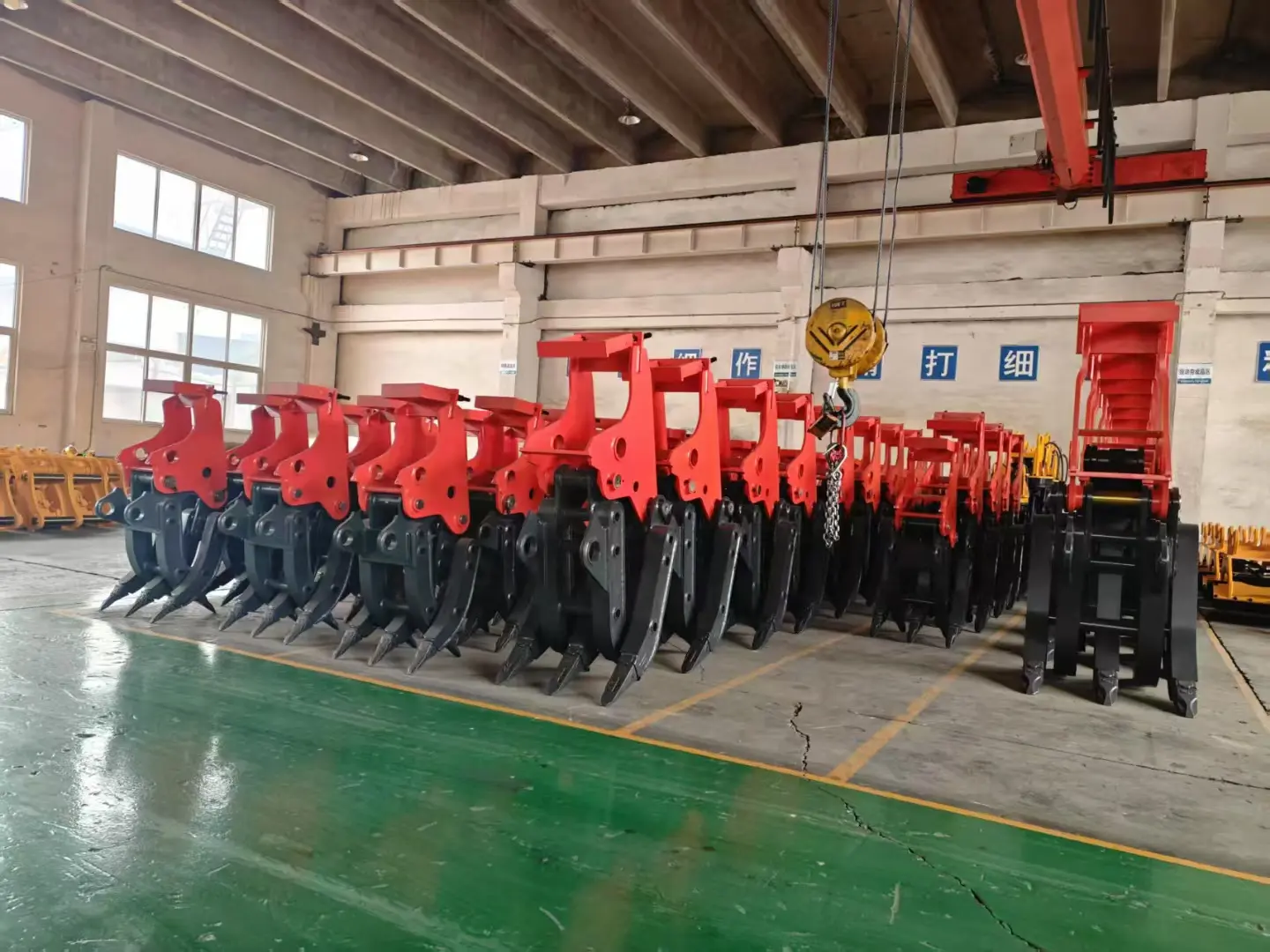
1. Demolition Grapple (aka Sorting Grapple)
Design: Twin or triplet tines, wide-opening jaws, durable structure.
Application: Demolition debris, sorting construction waste, light scrap handling.
Features: Wide jaw opening, high closing force, often includes a rotating head.
2.Log Grapple
Design: Curved arms for gripping round logs; sometimes with spikes or teeth.
Application: Forestry work, log loading, timber processing.
Features: Fixed or rotating design; heavy-duty build for outdoor rugged conditions.
3. Stone Grapple
Design: Flat-edged jaws, high clamping force.
Application: Handling rocks, boulders, large concrete blocks.
Features: High tensile steel, reinforced joints.
4.Orange Peel Grapple
Design: Multiple claw-like arms (usually 4–6), similar to an orange peel.
Application: Scrap yards, recycling, bulk material handling.
Features: Excellent volume handling, full 360-degree rotation.
5. Clamshell Bucket
Design: Two articulated buckets that close together.
Application: Digging, trenching, bulk materials like sand or grain.
Features: Used vertically, sometimes equipped with a rotator.
6. Thumb Grapple (Mechanical or Hydraulic Thumb)
Design: An additional articulated arm that works with the standard bucket.
Application: General-purpose grabbing – logs, pipes, branches, demolition.
Features: Cost-effective, commonly retrofit.
7. Pallet Fork Grapple
Design: Hydraulic clamp added to pallet forks.
Application: Lifting and transporting pallets or boxed goods.
Features: More precise than traditional forks.
Each grapple serves a unique purpose, and overlapping functions can often be managed with multi-purpose designs.

Key Factors to Consider When Choosing an Excavator Grapple
1. Work Application
Define the primary task. Will the grapple be handling demolition debris, logs, rocks, scrap, or mixed waste? For instance:
Demolition: Use a rotating demolition grapple.
Forestry: Go for a heavy-duty log grapple.
Scrap yard: Consider an orange peel grapple with 360-degree rotation.
2. Excavator Size and Weight Class
Always match the grapple to your excavator's size:
A 5-ton excavator won’t handle a grapple made for a 20-ton class.
Check the machine’s lifting capacity, hydraulic pressure, and flow rate.
Typical compatibility example:
| Excavator Weight Class | Grapple Weight Range | Compatible Grapple Types |
| 4–8 tons | 150–350 kg | Thumb, small sorting |
| 9–15 tons | 400–700 kg | Sorting, log, clamshell |
| 16–25 tons | 800–1300 kg | Demolition, stone |
| 26+ tons | 1300 kg+ | Orange peel, heavy duty |
3. Hydraulic Requirements
Ensure your excavator has the correct auxiliary hydraulics:
Single-acting (open/close only) or double-acting (bidirectional flow)?
Do you need an electro-hydraulic rotation circuit?
Know your hydraulic flow rate (L/min) and pressure (bar or psi).
Too much pressure can damage seals or frames; too little and the grapple won't function efficiently.
4. Rotation or Fixed Head
Rotating grapples: Allow 360° movement, ideal for precise placement, demolition, or confined spaces.
Fixed grapples: Cheaper, simpler, and good for straightforward lifting jobs.

5. Mounting and Quick Coupler Compatibility
Grapples come with different mounting options:
Direct mount: Bolted or pinned directly to the excavator arm.
Quick coupler-compatible: Faster changeover between attachments.
Always check your coupler size, pin diameter, and spacing.
6. Build Quality and Materials
Look for:
High-tensile steel frames
Hardened bushings and pins
Replaceable wear parts (blades, tines)
Reinforced pivot points and cylinders
A poorly made grapple will deform under stress and need frequent repair.
7. Maintenance and Service Access
Grapples with central lubrication points, easily replaceable bushings, and standardized cylinders will reduce downtime.
Ask the supplier:
How often should pins be greased?
Can parts be sourced locally or easily shipped?
8. Environmental Considerations
If operating in wet or abrasive environments (scrap yards, coastal zones), look for:
Corrosion-resistant coatings
Dust-proofed cylinders
Sealed pivot joints
Common Mistakes to Avoid
Oversizing the grapple: This strains the excavator and reduces maneuverability.
Ignoring rotation needs: Tasks requiring precise placement demand rotation.
Using general-purpose grapples for specialized jobs: Like using a thumb for bulk scrap.
Not checking hydraulic compatibility: Leads to poor performance or system damage.
Choosing low-cost imports without support: Parts and service could be unavailable.

Real-World Use Cases
Case 1: Urban Demolition Contractor
A contractor in Tokyo used a 14-ton excavator and upgraded from a fixed thumb to a rotating demolition grapple. Result: reduced manual sorting time by 60% and improved worker safety.
Case 2: Forestry Operator in British Columbia
Switching from a bucket + thumb to a dedicated log grapple allowed safer, faster timber loading, especially on slopes.
Case 3: Scrap Yard in UAE
An orange peel grapple with hydraulic rotation helped a recycling yard move mixed scrap faster and more efficiently with fewer dropped loads.
Questions to Ask Your Supplier Before Purchasing
Is the grapple fully compatible with my excavator model?
What type of tasks is it best suited for?
Can I get replacement parts locally?
Does it come with installation support?
What warranty and after-sales service is provided?
The right hydraulic grapple enhances your excavator's productivity, minimizes downtime, and adapts your machine to a range of specialized tasks. With proper evaluation of the job requirements and a clear understanding of hydraulic compatibility, you can invest confidently in the right excavator grapple for long-term success.
Excavator arm extension for demolition work: what to consider
How to transport long arm excavators safely ?