How to transport long arm excavators safely ?
Why Transporting Long Arm Excavators Is a Unique Challenge
Standard excavators are already among the heaviest and most dimensionally challenging machines to move. A long arm amplifies the complexity. Here’s why:
Extended dimensions: A long boom and stick can increase the machine’s total length by several meters.
Weight distribution issues: Added mass toward the front of the excavator can cause unbalanced loading.
Clearance hazards: Tall or angled arms may violate bridge, tunnel, or overpass height restrictions.
Permitting complications: Oversized loads often require transport permits, escort vehicles, and restricted routing.
Stability during transport: Improperly secured arms or attachments can swing or shift during transit.
Understanding these issues is the first step toward building a safe and efficient transportation plan.
Step-by-Step Guide to Safe Long Arm Transport
1. Initial Assessment and Preparation
Before moving any equipment, a proper assessment must be made. This includes:
Measuring the machine with the long arm installed: total length, width, height, and weight.
Identifying attachment types: Is it a standard long boom, a demolition arm, or a telescopic extension?
Inspecting the condition of the boom, hydraulic lines, and mounting pins to ensure there’s no risk of mechanical failure during transit.
Deciding whether to ship the arm attached or detached—a critical choice discussed further below.
Without this preparation, the transport process may encounter unexpected obstacles, especially during inspections or at weigh stations.
2. Detach the Long Arm When Possible
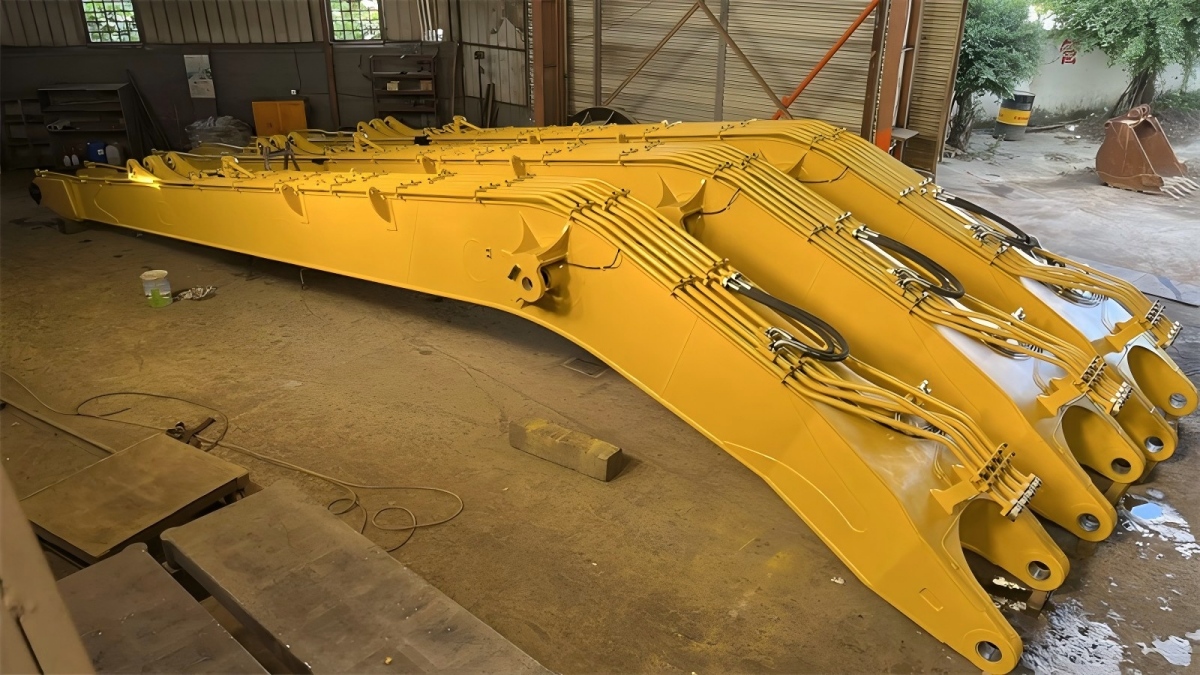
One of the most effective ways to simplify long arm transport is to remove the boom and stick from the excavator before shipping.
Benefits of Detaching:
Reduces the machine’s height and length significantly.
Decreases the center of gravity, making the load more stable.
Eases compliance with transport regulations in most countries.
Avoids the need for costly permits and route restrictions.
Common practice: The long arm is detached and shipped on a separate flatbed trailer alongside the base machine.
Requirements:
Proper lifting equipment (e.g., crane or gantry) to detach and load the arm safely.
Technicians to handle hydraulic disconnections and protect hose ends from contamination.
Secure crating or bracing to hold the arm in place during transit.
If detaching is not feasible due to tight timelines or equipment limitations, alternative transport strategies must be adopted.

3. Choose the Right Trailer Type
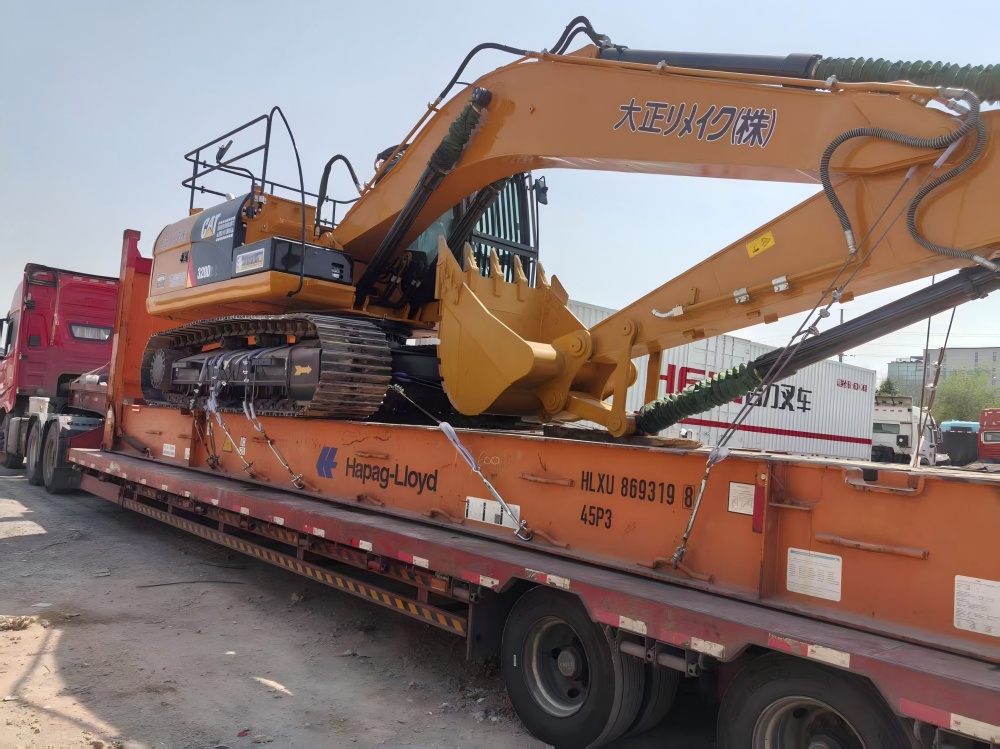
For long arm excavators that must be transported with the arm attached, selecting the correct trailer is essential for safety and compliance.
Common trailer types:
Lowboy/Low-bed trailers: These provide a lower deck height and are commonly used for heavy construction equipment. Ideal when overall machine height is a concern.
Extendable trailers: Used when the machine's length exceeds standard trailer dimensions.
Drop deck trailers: Offer a step-down section to accommodate taller equipment safely.
The trailer must be rated for the total weight and designed to distribute load evenly. Axle group spacing also plays a role in road legality.
4. Proper Machine Positioning on the Trailer
How the excavator is loaded onto the trailer can make a significant difference in excavator safety during transit.
Key tips:
Position the excavator facing backward if the long arm will extend over the trailer’s rear. This helps with balance and reduces overhang.
Retract the boom and stick as much as possible. Use the machine’s hydraulic system to fold the arm tight.
Avoid sharp angles that increase height. When folded, the arm should follow the trailer’s contour as closely as possible.
Tilt the stick inward toward the machine body to reduce forward reach.
Any movement or “play” during driving can cause damage or instability. The goal is to keep the machine compact and firmly supported.
5. Secure the Load with Heavy-Duty Tie-Downs
Tie-down is not a formality—it’s a critical step for safety. Especially with longer arms, securing every part of the machine is essential.
Best practices:
Use rated chains and binders for the main body and tracks.
Tie down the boom and stick separately using independent chains or straps.
Install anti-swing brackets or use wood blocking to prevent the arm from swaying.
Attach multiple anchor points to prevent shifting during sudden stops or turns.
Secure any auxiliary attachments (buckets, breakers) separately, never left dangling.
Compliance with DOT (or relevant national authority) tie-down regulations is mandatory to avoid fines and prevent accidents.

6. Check Route Restrictions and Permitting
Oversized loads such as long arm excavators may not be legal to travel on all roads.
Steps to take:
Obtain transport permits for oversize height, length, or weight if applicable.
Route planning should consider bridge clearances, overpasses, and road width.
Avoid urban centers, school zones, or restricted hours unless authorized.
In many regions, loads exceeding specific thresholds must be accompanied by escort vehicles.
Failure to plan a legal route can lead to delays, forced detours, or fines.
7. Loading and Unloading Safety Measures
Many accidents during long arm transport occur not on the road, but during loading and unloading. Here's how to reduce the risk:
Ensure the loading surface is level and compacted, especially on dirt sites.
Use spotters and two-way communication (radios or hand signals) to guide the operator.
Keep all bystanders well clear of the machine.
Verify clearance height overhead, including power lines, trees, or structures.
Always engage the machine’s travel lock or swing lock if available.
Once on the trailer, shut off the engine and remove the key.
When unloading, repeat the same steps in reverse—and always inspect the equipment before use.
8. Weather and Road Conditions
Bad weather can turn a manageable move into a hazardous one.
Avoid transporting long arm machines in high wind conditions, especially if the arm is extended or loosely secured.
Wet or icy roads can reduce trailer traction, increasing the risk of load shift.
Rain can make loading ramps slippery—use grip mats or wait for drier conditions if possible.
A last-minute check of road and weather conditions can prevent costly damage or downtime.
Field Example: Urban Flood Channel Dredging
In southern China, a contractor needed to move a 22-ton excavator fitted with a 14-meter long arm to a downtown flood channel dredging site. The site was surrounded by narrow roads, low bridges, and heavy traffic.
To manage this, the transport team:
Detached the long arm, shipping it on a separate 40-foot flatbed trailer.
Reduced the main unit’s height to under 3.8 meters using a low-bed trailer.
Scheduled nighttime transport, avoiding peak hours and obtaining municipal permits.
Used two spotters during loading/unloading due to tight access conditions.
As a result, the excavator was delivered and operational within 48 hours without incident.
Common Mistakes to Avoid
Transporting long arm excavators can go wrong in many ways if precautions are skipped. Here are some typical errors and how to avoid them:
| Mistake | Risk | Prevention |
| Not measuring total dimensions | Legal violations | Always measure with arm folded or extended |
| Skipping permit process | Fines, impound | Contact local transport authorities in advance |
| Loose arm during transit | Swinging hazard | Use separate tie-downs and anti-sway braces |
| Loading without spotter | Equipment damage | Always assign trained personnel for guidance |
| Using unsuitable trailer | Trailer damage, load instability | Match trailer type to weight and dimensions |
A successful transport job depends on attention to detail and a commitment to safety, not just speed.
Transporting a long arm excavator is a serious responsibility. From understanding the equipment’s unique geometry to choosing the right trailer and planning the safest route, every step matters. With proper planning, technical knowledge, and a focus on excavator safety, contractors and equipment dealers can move even the largest machines efficiently—without risking downtime, damage, or danger on the road.
How to choose the right hydraulic grapple for your excavator?
How to increase efficiency in earthmoving with the right excavator arm ?