How Is Excavator Bucket Capacity Measured in Real Construction Projects

Understanding Why Bucket Capacity Matters on Real Jobsites
On active construction projects, the capacity of an excavator bucket is one of the most practical factors that determines productivity, fuel consumption, cycle time, and overall jobsite efficiency. While manufacturers provide standard capacity values, real-world conditions often make the “official number” different from the actual amount of material a bucket can carry. Because of this, excavator bucket capacity is often measured in multiple ways depending on soil type, project demands, safety rules, and the operator’s digging habits.
Contractors, fleet managers, and equipment suppliers increasingly pay attention to bucket capacity because accurate measurement affects production estimates, cost forecasting, transport planning, and even machine selection. Understanding how capacity is calculated in real situations helps avoid delays and ensures the excavator is matched correctly to the job.
Bucket Capacity Definitions Used in the Industry
1. Struck Capacity
Struck capacity is the simplest and most controlled measurement.
It reflects how much material the excavator bucket can hold when the top surface of the load is level—flat across the edges.
Used for consistent comparison between bucket models
Does not reflect actual digging results
Mainly used in engineering drawings, catalogs, and manufacturing standards
This value is usually smaller than the real loading volume on site.
2. Heaped Capacity
In real construction projects, excavator bucket capacity is often measured in heaped terms.
This refers to material piled above the bucket’s edge surface, usually forming a mound.
Industry standards usually use a 1:1 slope from the cutting edge to the top of the heap.
Heaped capacity is more realistic because operators rarely fill the bucket perfectly flat. Most soil types naturally heap unless they are extremely wet or sticky.
3. Volumetric Capacity for Non-Soil Materials
When handling aggregates, mining material, coal, sand, or waste, the bucket’s effective capacity depends on material density and flowability.
Examples:
Wet clay reduces usable capacity
Dry sand increases flow and filling efficiency
Crushed stone settles differently and may reduce heap angle
This is why excavator buckets designed for aggregates often differ in shape from general-purpose buckets.
Real Jobsite Methods for Measuring Bucket Capacity
1. Water Filling Test
Although not used daily, water filling is the most accurate field method:
Seal the cutting edge
Fill the bucket with water
Measure total liters
Convert liters to cubic meters
This eliminates the effect of material density and is used when bucket capacity must be certified.
2. Weight-Based Capacity Estimation
Some contractors measure capacity by weighing the load:
Load material into a truck with a known weight
Weigh the truck on a scale
Calculate the average volume per bucket
Apply material density formulas
Useful when measuring production rates for large earthmoving projects.
3. Cycle-Time Production Testing
In daily operations, foremen estimate capacity indirectly:
Count buckets loaded into a truck
Multiply by nominal bucket capacity
Adjust based on material behavior
Even though this method is not scientific, it helps determine how many excavator buckets are needed to fill a dump truck or support continuous workflow.
Factors That Change Bucket Capacity on Site
1. Material Conditions
Dry soil → higher actual volume
Wet clay → lower effective capacity
Rocky mix → reduces fill efficiency
Material condition plays the biggest role in real-world measurements.
2. Bucket Shape and Wear
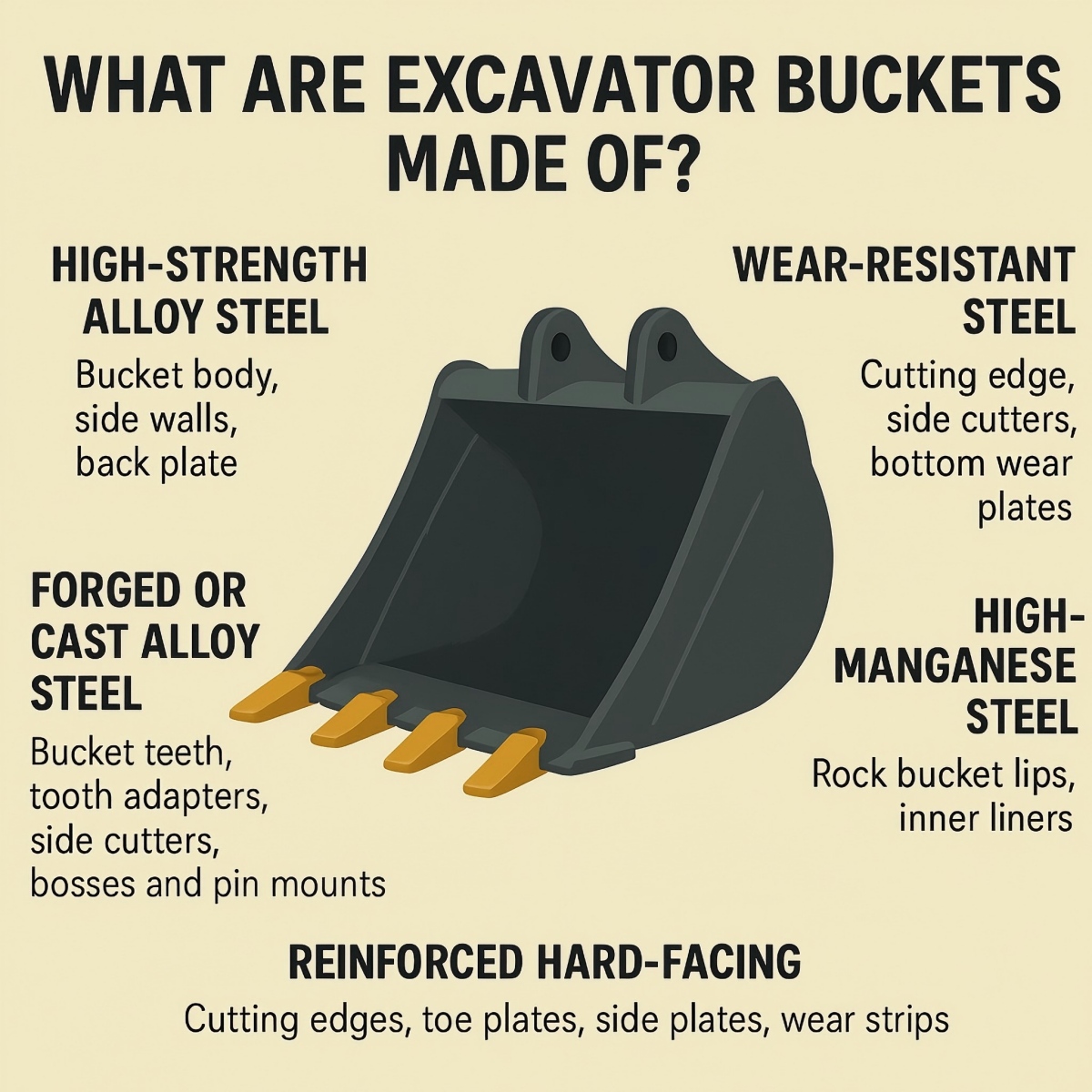
Wear on cutting edges, side plates, or teeth reduces internal space.
General-purpose buckets, rock buckets, trenching buckets, and heavy-duty buckets all have different internal dimensions and fill behaviors.
3. Operator Skill
Excavator bucket capacity is often measured in real work by how efficiently the operator uses the machine:
Smooth loading increases fill percentage
Correct bucket angle prevents spillage
Skilled operators reach 85–100% of rated heaped capacity
Inexperienced operators may reach only 60–80%
4. Machine Compatibility
An oversized bucket reduces breakout force, causing the operator to take smaller bites.
An undersized bucket increases cycle time.
Correct match = accurate capacity.
How Contractors Use Bucket Capacity in Project Planning
1. Estimating Earthwork Volume
Production planning uses bucket capacity × cycle rate to predict:
Daily output
Labor allocation
Fuel cost
Machine scheduling
2. Matching Dump Trucks and Excavators
On real jobsites, the bucket size determines:
How many passes to fill a truck
Whether the excavator and truck pairing is efficient
Whether the truck is overloaded or underloaded
Example:
A 1.0 m³ bucket typically fills a 10 m³ truck in 8–10 passes.
3. Correct Bucket Selection Reduces Fuel Consumption
A bucket that matches the soil and project increases:
Engine efficiency
Hydraulic speed
Wear life
Per-hour productivity
Common Bucket Sizes Used in Real Construction Projects
| Excavator Class | Typical Bucket Capacity | Notes |
| 1–3 ton | 0.02–0.08 m³ | Landscaping, trenching |
| 3–8 ton | 0.1–0.3 m³ | Utilities, light earthwork |
| 8–15 ton | 0.4–0.7 m³ | Building sites |
| 20–30 ton | 0.8–1.5 m³ | General construction, mining |
| 30–50 ton | 1.6–3.0 m³ | High-volume work |
Actual capacity varies with bucket shape, material, and jobsite conditions.
Practical Tips for Measuring Bucket Capacity Accurately
Always check manufacturer’s struck and heaped values
Adjust for soil density
Consider operator skill
Measure real output using cycle-time testing
Recalculate capacity after heavy wear or repair
Match truck size to bucket capacity for minimum idle time
Final Thoughts from Real Jobsite Experience
In real construction projects, excavator bucket capacity is often measured in more than just one standard number.
Material type, bucket shape, jobsite conditions, machine model, and operator technique all influence the actual volume a bucket can carry. Contractors, engineers, and equipment suppliers must consider both rated capacity and real-world capacity to ensure the excavator is performing at its highest efficiency.
A properly measured and correctly paired excavator bucket means:
faster cycle times
stable production estimates
lower fuel consumption
fewer machine overload risks
smoother coordination with dump trucks and other equipment
Understanding how capacity works in the field helps avoid project delays and ensures consistent jobsite productivity.
How to Match Used Bobcat Excavator Buckets with Your Machine Model
What Are Excavator Buckets Made Of
Related Article