Safety Tips When Using Long Arms on Slopes
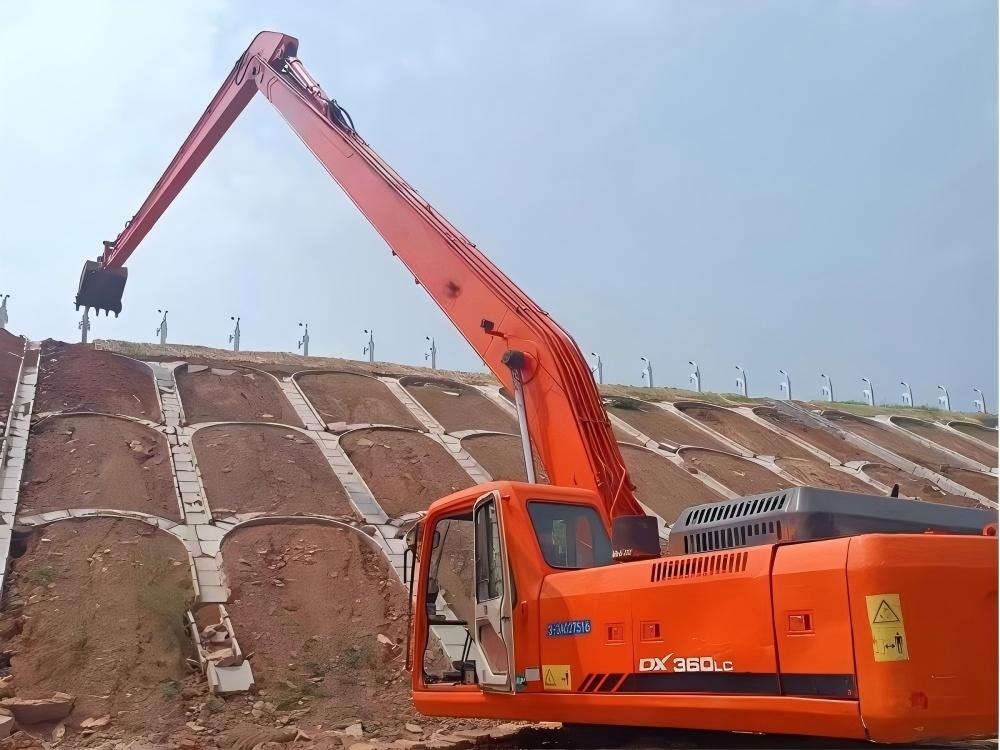
At Dewanda, our team has supplied hundreds of custom long arms for slope-related applications—riverbank maintenance, dam projects, drainage ditches, hillside stabilization, and foundation excavation on inclined terrain. We know the demands of real-world environments, and we’ve worked closely with contractors to reinforce safety at every level: from the structural design of the arm to operator procedures on the job site.
The Risk Factors: Why Slopes and Long Arms Don’t Mix Easily
Using a long arm on flat ground already introduces increased structural loads, flexion stress, and balance challenges. When you add a slope, those risks grow exponentially. Here’s why:
1. Shifted Center of Gravity
A standard excavator has a low center of gravity, designed for stability. However, a long arm significantly shifts the working mass forward. On a slope, this imbalance becomes more pronounced, increasing the risk of forward tipping—especially when the bucket is loaded.
2. Reduced Ground Contact
Rubber or steel tracks may not fully grip the ground on uneven or soft slopes. With partial contact or loose footing, the machine may slide or roll.
3. Load Amplification
The physics of leverage means a 12-meter arm creates far greater force on the boom base and swing bearing than a standard-length arm. On a slope, this can create asymmetrical loading, accelerating fatigue or even causing weld failures.
4. Soil Failure
Sloped terrain often has looser or recently cut earth. If the ground under the track or under the working radius gives way, it may cause collapse or sudden tilting.
5. Visibility and Control Limitations
On slopes, the operator’s visual angle is distorted, and control feel becomes inconsistent. Small errors in joystick input may cause the boom or bucket to swing unexpectedly.
Dewanda’s Engineering Response
At Dewanda, we design our long arms with slope operation in mind. This includes:
Reinforced pivot zones and added gussets at stress points
Extended base plates to distribute stress evenly
Balanced counterweight calculations based on slope incline, arm length, and intended bucket type
Hydraulic cylinder upgrades to manage longer force arms
Customizable tilt angles for applications involving slope-side drainage
We also assist clients in selecting the correct counterweight setup and undercarriage configuration to support safe operation.

Safety Practices for Long Arm Use on Slopes
While equipment design plays a critical role, operator behavior and site planning are equally important. The following are proven safety practices based on real project experience.
1. Assess Slope Angle Before Deployment
No long arm should be operated on a slope exceeding the machine's rated gradeability. For most 20-ton class excavators, this is maximum 30° without load, and 15–20° under full load with extended reach.
Use a digital inclinometer or slope meter to assess the ground before mobilization. If the slope is borderline, consider preparing a work platform or cutting a step shelf.
2. Always Work Uphill–Downhill, Not Sideways
When working on a slope, the safest orientation is with the tracks pointing uphill and downhill. Side-facing operations dramatically increase the risk of tipping when the long arm is extended to the side.
Excavators with a long arm should never traverse across a slope unless the ground is compacted, levelled, and the arm is fully retracted.
3. Retract the Arm When Traveling
Before repositioning on a slope, always retract the boom and arm, and keep the bucket close to the machine. A fully extended arm significantly increases the risk of rollovers during travel.
Operators should travel slowly, keep movements smooth, and avoid sudden braking or swing motions.
4. Use Counterweights Properly
At Dewanda, we calculate recommended counterweights based on arm length and work radius. However, operators must verify these are installed properly on-site.
Adding extra counterweight without consulting a structural engineer may overload the swing bearing or frame. Always match counterweight additions to Dewanda’s specification for that arm model.
5. Avoid Full Extension at Max Slope
Even if the slope is technically within spec, avoid working at full reach with a full bucket when positioned on an incline. The tipping moment is greatest in this position.
Instead, break the task into smaller scoops, maintain a closer working radius, or consider using a stepped excavation method.
6. Stabilize the Ground
Soft, wet, or newly disturbed soil is a high-risk surface on a slope. Reinforce work platforms with crushed stone or steel plates where needed.
On riverbanks or embankments, deploy steel mats or trench boxes to prevent collapse while digging with a long arm.
7. Install Anti-Roll Alarms or Monitors
Some contractors working on critical slope jobs install tilt alarms or load sensors to warn operators when the machine approaches unsafe angles.
This technology is especially helpful on projects with frequent slope transitions or when visibility is limited due to weather or terrain.
8. Choose Attachments Carefully
Long arms amplify the load of any attachment. On slopes, use lightweight buckets with narrow widths to minimize swing torque.
Avoid using heavy rippers, hammers, or grapples at full extension on slopes unless the machine has been custom balanced and structurally certified.
9. Use a Spotter
Having a trained spotter on the ground helps guide the operator and assess ground movement, attachment positioning, or signs of machine instability.
Many Dewanda clients use radio-equipped spotters to assist during river work or deep cuts on inclined terrain.
10. Train Operators on Long Arm-Specific Risk
Long arm excavation is not the same as using a standard boom. Train your operators to understand:
The swing limitations
Load radius curves
Ground pressure variance
Vibration effects on steep terrain
Some clients even run mock slope simulations in yards before working live.

Case Studies from Dewanda Projects
Slope Trenching in Northern Vietnam
A contractor used a Dewanda 13-meter arm for flood channel trenching. To ensure safety:
The team built stepped access platforms
Operators were trained to keep the arm retracted when crossing slopes
Counterweight was increased by 1.8 tons per Dewanda guidance
The project completed with zero tip incidents over three months of slope-side trenching.
Dam Desilting in Western Turkey
On a steep bank dam desilting project, a customer used a Dewanda boom with a clamshell bucket. The terrain varied from 18° to 25° slopes.
To manage risk:
A GPS tilt alarm system was installed
A two-operator system was used (operator and slope guide)
The boom design included reinforced lower mountings
Feedback from the client:
“The machine remained extremely stable even during full bucket swings. The Dewanda design allowed us to work faster without worrying about stress failures.”
Excavation for Wind Turbine Bases in Brazil
Sloped terrain required excavation of circular foundations up to 4 meters deep on 10–15° grades.
With Dewanda’s help, the client implemented:
Rubber track mats for slope traction
Slope-to-horizontal transition planning to reduce machine tilt
Step-cutting technique instead of deep single digs
The use of custom-designed 10.5-meter arms with pre-mounted hydraulic lines made this process both safe and time-efficient.
Dewanda’s Design Standards for Slope-Ready Arms
We engineer our long arms for clients operating in sloped, irregular terrain with:
Double-welded joints at stress areas
Side plate thickening near pivot and articulation zones
Underside reinforcement to prevent deformation from repetitive shock
Greaseable joints with dust-sealing bushings to maintain performance in muddy conditions
Bolt-on counterweight compatibility for field tuning
We also test all slope-configured arm assemblies under simulated angular loads and verify torsional performance prior to delivery.
Excavator Arms in the Mining Sector: How Dewanda Heavy Arms Perform Under Extreme Conditions
Why Your Excavator Needs a Quick Coupler
Related Article