The Rise of Telescopic Arms in Urban Excavation
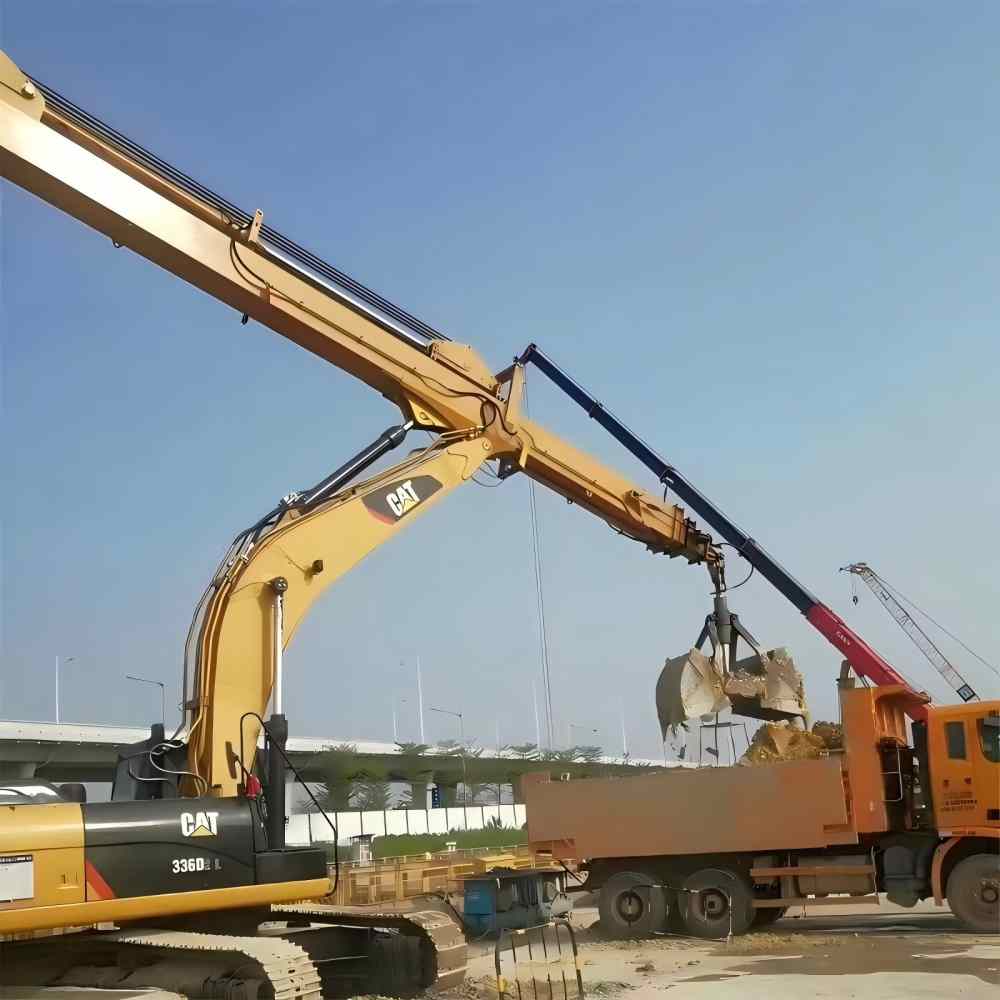
Unlike traditional boom and arm assemblies, telescopic arms extend and retract with precision, allowing operators to reach greater depths or distances within compact urban job sites—without needing to reposition the entire machine.
Why Urban Sites Demand a Different Approach
City excavation jobs typically involve tight quarters—alleyways, basements, narrow roads, and areas close to pedestrian zones. Traditional excavator arms can be bulky and require significant swing space. Even compact machines struggle to maneuver in constrained environments.
Urban excavation constraints include:
Limited working footprint: Many sites can’t accommodate large machinery.
Depth challenges: Digging deep for foundations, lift shafts, or underground utilities without disrupting the surroundings is essential.
Underground congestion: Pipes, cables, and other infrastructure must be avoided with precision.
Noise & dust restrictions: Equipment must be efficient, with minimal disturbance to local residents.
Height limitations: Overhead power lines, bridges, and building eaves limit boom movement.
These factors have driven the demand for equipment that can offer deep reach, flexible movement, and low space consumption—making the telescopic arm a perfect fit.
What is a Telescopic Arm?
A telescopic arm is an extendable hydraulic mechanism mounted on an excavator. Unlike fixed-length arms, the telescopic variant comprises multiple nested sections—like a telescope—that can slide out and retract hydraulically. Most systems also include a sliding inner boom and sometimes even chain-driven internal hoses or cable management systems.
Variable reach lengths
Reduced machine repositioning
Increased digging precision
Minimal impact on site logistics
Quick vertical access for deep shafts
Some telescopic arms are also paired with clamshell buckets or grab systems, making them ideal for vertical shaft excavation, pile cleaning, or manhole installations.
Telescopic Arm vs Long Arm: A Strategic Choice
It’s easy to confuse telescopic arms with long reach (extended) arms, but their applications are quite different.
| Feature | Telescopic Arm | Long Reach Arm |
| Reach | Adjustable dynamically | Fixed extended length |
| Best For | Deep, vertical shaft excavation | Wide, horizontal reach like rivers or slopes |
| Mobility | Compact when retracted | Bulky, needs more swing space |
| Urban Suitability | Excellent | Limited |
| Attachments | Often paired with grab or clamshell | Usually bucket only |
In urban jobs, where space and precision matter more than reach distance alone, telescopic arms often outperform long-arm configurations.
Real-World Applications in Urban Environments
1. Basement and Underground Parking Construction
One of the most common uses of telescopic arms is in basement excavation, especially in densely packed city centers. When access ramps can’t be built and headroom is limited, a telescopic arm can dig vertically and lift materials without increasing the machine’s footprint.
In Tokyo, Singapore, and Hong Kong, many high-rise buildings now rely on telescopic-arm-equipped excavators for their foundation work. They reduce noise and require fewer support workers on the ground.
2. Subway Station Expansion and Tunnel Work
Urban rail expansion projects often involve work in confined, irregularly shaped spaces where full-sized excavators can’t operate. Telescopic arms can be deployed from above through narrow shafts, reaching deep underground to handle spoil removal or material placement.
Some units operate with remote control, increasing operator safety when deployed inside partially built tunnels.
3. Utility Repair and Vertical Shaft Cleaning
In European cities, older sewage and water systems often require shaft cleaning or deep pit access in the middle of roads or sidewalks. Municipalities use compact excavators with telescopic arms to avoid digging large trenches.
One utility company in Berlin reduced traffic disruption by 60% simply by using telescopic arms for manhole refurbishment.
4. Building Demolition (Vertical Debris Removal)
Some demolition contractors are pairing telescopic arms with grapple or clamshell attachments to remove debris vertically from multistory buildings, especially where side access is blocked. This approach minimizes falling debris, increases control, and speeds up interior gut-out work.
Manufacturing and Technical Challenges
The success of a telescopic arm depends heavily on hydraulic precision, structural reinforcement, and material quality. Nested arm sections experience extreme stress when fully extended, especially with heavy loads.
Manufacturers must address:
Structural fatigue: Reinforced steel, proper welding, and gusset placement are essential.
Hydraulic synchronization: Smooth extension and retraction without jerks or delays.
Internal hose routing: Preventing wear and ensuring pressure consistency across sections.
Seal integrity: To prevent hydraulic leaks over time.
Some companies, like Dewanda, have begun integrating robotic welding and custom seal kits to enhance durability and reduce field failures in urban telescopic arms.
The Market Outlook
The global demand for telescopic arms is rising steadily. Driven by urbanization and the expansion of underground infrastructure, contractors are actively seeking machines that can reduce environmental impact while maintaining productivity.
According to recent industry forecasts, the telescopic arm market is expected to grow at a compound annual growth rate (CAGR) of over 6% through 2030, with the highest adoption in Southeast Asia, Europe, and the Middle East.
Municipal procurement agencies are also recognizing the value. In some cities, tenders for public excavation projects now require the use of telescopic-arm equipment to reduce surface-level disruption and speed up vertical access.
Choosing the Right Telescopic Arm
When selecting a telescopic arm for your urban project, consider the following:
Machine compatibility: Ensure the base excavator’s hydraulic flow matches the arm’s requirement.
Digging depth: Telescopic arms can vary from 6m to over 20m reach.
Payload limits: Deeper reach often reduces lift capacity—check specs carefully.
Attachment integration: Clamshells, grapples, and even cameras can be integrated.
Serviceability: Look for modular designs and easy access to hydraulic cylinders.
It's also essential to partner with suppliers who offer real after-sales support. Dewanda, for example, provides customized telescopic arm solutions with engineering drawings and training for local operators—ensuring safer, more efficient operation.
Urban excavation is evolving fast. What once required massive machines and long project durations is now being handled by compact excavators with smart attachments like the telescopic arm. As cities grow taller and dig deeper, tools that offer precision, flexibility, and reduced disruption will continue to define the next generation of urban construction.
The telescopic arm is no longer an exotic attachment—it’s becoming the new standard.
Why Your Excavator Needs a Quick Coupler
The Story Behind Dewanda's Signature Arm Welds
Related Article